As agents become more autonomous, human attention becomes the bottleneck.
Building an AI agent is not just pointing a model at a pile of documents and waiting for a report. Producing output is the easy part.
The hard part is trust.
The biggest risk with AI agents is not that they fail loudly. It’s that they fail confidently. A wrong answer looks exactly like a right one. And an agent checking its own result tends to agree with itself.
Working on AI systems for complex projects has made this especially clear to me. So the real question isn’t “Can AI do the work?” It’s “How do we know when to trust it?”
Never let one agent grade its own work
There’s an architecture pattern built for exactly this. The idea is simple: never let one agent grade its own work.
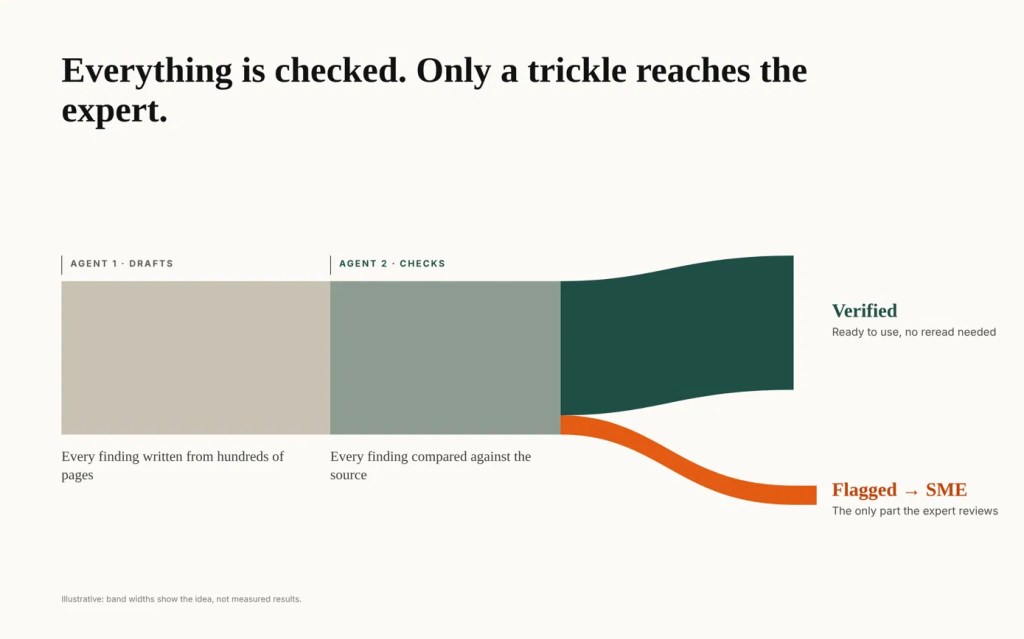
- Agent 1 does the work. Reads the documents, checks the requirements, drafts the findings.
- Agent 2 checks it. Independently. Fresh context. Against the source documents. And instead of a simple pass or fail, it assigns a confidence level to every finding: high confidence when it is clearly supported with a reference, flagged when it is ambiguous, incomplete, or conflicting.
- The human expert makes the call. But not on everything. Only where it matters.
Why confidence levels change everything
Without confidence levels, “human-in-the-loop” usually means one of two things: the expert rereads everything (and AI saved no time), or the expert skims everything (and AI added risk).
With confidence levels, the expert doesn’t start on page one. They start on the flags. Their experience goes to the conflicting document, the vague clause, the judgment call. Not to confirming what the sources already say clearly.
Two rounds of checking instead of one
Each round has a different strength. The AI reviewer never gets tired: it checks every item, every time. The human expert knows what “looks right but isn’t.” Speed from one. Judgment from the other.
The future of agentic AI isn’t removing the expert. It’s protecting the expert’s attention.
Where do you put the human in your agent workflows?

